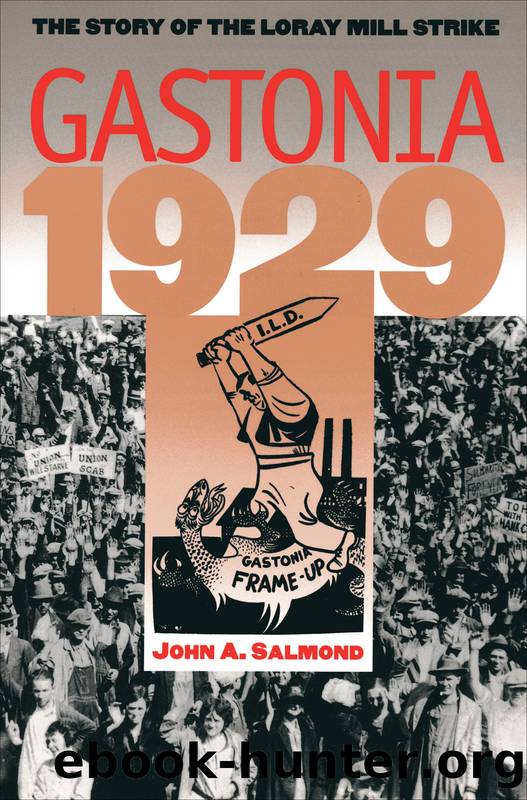
Gastonia 1929: The Story of the Loray Mill Strike by John A. Salmond
Author:John A. Salmond [Salmond, John A.]
Language: eng
Format: epub
Tags: History, Labor & Industrial Relations, Political Science
ISBN: 9781469616933
Google: RIEeBQAAQBAJ
Goodreads: 26522450
Publisher: UNC Press Books
Published: 1995-11-20T00:00:00+00:00
John Carpenter, Gaston County solicitor (Line drawing by Fred Ellis, originally published in the Labor Defender)
The hearing of the prosecutionâs evidence had barely started when there was a sensational development. Medical evidence on the extent of the injuries to Aderholt, Roach, Gilbert, and Ferguson was being heard when, on a signal from Carpenter, the courtroom doors were opened and a life-sized wax effigy of the slain police chief, dressed in a ten-gallon hat and the blood-stained clothes he had been wearing the night of June 7, was wheeled into the courtroom. The effigyâs entrance caused pandemoniumââa half-stifled wailâ from Aderholtâs widow, consternation in the jury box, laughter from the reporters present, and angry objections from the defense. Carpenter said that he needed the figure in order to explain the nature of Aderholtâs wounds, but Barnhill would not listen. He ordered the effigy to be removed forthwith, both from the courtroom itself and from the adjacent office areas, though the clothes were admitted as evidence. Normal proceedings were then resumed, but already, reported the Charlotte Observer, â[the effigyâs] gruesomeness had had a telling effect on the jury.â19
This bizarre stunt had apparently been inspired by a popular Broadway play of the 1920s, The Trial of Mary Duigan, which had recently been filmed and had had a long run in both Charlotte and Gastonia. In the film, though, it was the defense that used a dummy, dressed up in the victimâs clothes, to prove that the diminutive Mary could not possibly have struck the fatal blow. The prosecution really had no reason to pull the stunt, which was ânew to courtrooms of this or any other state,â except for its sensational effect. The effigy, incidentally, was no hastily constructed affair but had been carefully molded over the previous three weeks by a Gastonia lad, at a cost of one thousand dollars. He had worked secretly in the courtroomâs basement, which explained the reported sightings of Aderholtâs ghost.20
The stateâs evidence followed a fairly predictable pattern, or so the Daily Worker thought. The witnesses provided âa maze of perjury and contradiction,â which was hardly surprising, given that the trial was merely a show, masking âthe real issue of class against class.â The result was a foregone conclusion, the paper predicted, the legal lynching of the âleaders of the textile workers.â There was certainly a predictability to the prosecutionâs witnesses. All of those who, like âstar witnessâ Otto Mason, claimed to have seen the whole incident were present or former employees of the Loray Mill. And all of them told essentially the same story: that Beal had previously urged the strikers to âget to the millâ and force the night shift out, if necessary; that the strike guards had fired the first shots; and that they had done so at the urging of Beal and Buch, who could clearly be heard shouting âShoot himâ and âDo your duty, guardsâ as the struggle between Gilbert and Harrison began. They were all adamant that it was McGinnis who fired the first shot; Tom Gilbert even asserted that it was McGinnisâs first shot which hit him.
Download
This site does not store any files on its server. We only index and link to content provided by other sites. Please contact the content providers to delete copyright contents if any and email us, we'll remove relevant links or contents immediately.
The Secret History by Donna Tartt(19088)
The Social Justice Warrior Handbook by Lisa De Pasquale(12190)
Thirteen Reasons Why by Jay Asher(8909)
This Is How You Lose Her by Junot Diaz(6886)
Weapons of Math Destruction by Cathy O'Neil(6279)
Zero to One by Peter Thiel(5802)
Beartown by Fredrik Backman(5754)
The Myth of the Strong Leader by Archie Brown(5507)
The Fire Next Time by James Baldwin(5444)
How Democracies Die by Steven Levitsky & Daniel Ziblatt(5218)
Promise Me, Dad by Joe Biden(5153)
Stone's Rules by Roger Stone(5088)
A Higher Loyalty: Truth, Lies, and Leadership by James Comey(4963)
100 Deadly Skills by Clint Emerson(4925)
Rise and Kill First by Ronen Bergman(4788)
Secrecy World by Jake Bernstein(4753)
The David Icke Guide to the Global Conspiracy (and how to end it) by David Icke(4718)
The Farm by Tom Rob Smith(4509)
The Doomsday Machine by Daniel Ellsberg(4490)
